
A Modular Monolith is a single deployable application organized into well-defined, loosely coupled modules, each owning its data, logic, and API surface. You keep one deployment, usually one database, and one transaction boundary while enforcing real business boundaries inside the codebase. For most .NET systems, it's the right architecture.
Every .NET team eventually hits the same fork: the monolith is turning into a mess, but microservices look expensive to operate. The Modular Monolith is the third option. This guide links the articles on building one in .NET: defining module boundaries, isolating data, communication patterns, testing strategies, and extracting microservices when a module actually needs it.
What is a Modular Monolith?
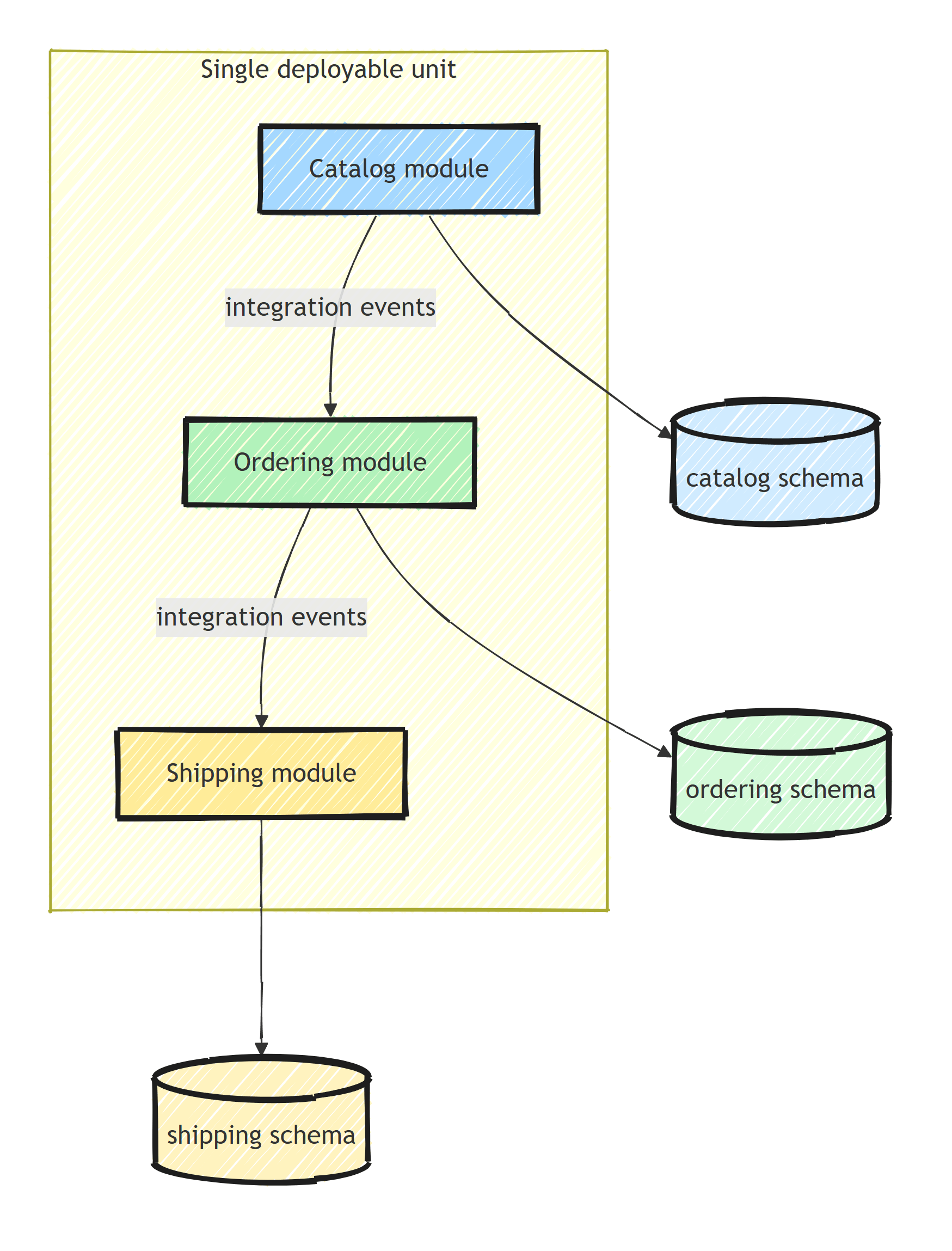
A Modular Monolith is a software architecture style where a single deployable unit is organized into well-defined, loosely coupled modules. Each module encapsulates a specific business capability with its own data, logic, and API surface.
Unlike a traditional monolith, the boundaries between modules are explicit and enforced. Unlike microservices, you deploy a single application, usually backed by a single database, and avoid distributed system complexity.
My Modular Monolith Architecture course covers the approach I use for building production systems.
Getting Started
These articles introduce the core concepts and help you understand when a Modular Monolith is the right choice for your project.
- What Is a Modular Monolith?
- Monolith to Microservices: How a Modular Monolith Helps
- Scaling Monoliths: A Practical Guide for Growing Systems
- Modular Monolith vs Microservices: How to Choose
- How to Build a Modular Monolith in .NET Step by Step
Module Boundaries and Data Isolation
Getting module boundaries right is the most important design decision. These articles cover how to define boundaries, isolate data, and enforce separation.
- Modular Monolith Data Isolation
- How to Keep Your Data Boundaries Intact in a Modular Monolith
- Internal vs Public APIs in Modular Monoliths
- Refactoring Overgrown Bounded Contexts in Modular Monoliths
- Defining Module Boundaries with Bounded Contexts
- Schema-per-Module vs Database-per-Module
- The Shared Kernel Pattern in a Modular Monolith
Communication Patterns
Modules need to communicate without creating tight coupling. These articles cover synchronous and asynchronous patterns for inter-module communication.
- Modular Monolith Communication Patterns
- Orchestration vs Choreography
- How to Use Domain Events to Build Loosely Coupled Systems
- Building a Custom Domain Events Dispatcher in .NET
- Event-Driven Communication Between Modules
- Why the Outbox Pattern Solves the Dual-Write Problem
- The Saga Pattern in a Modular Monolith
Testing
Testing a Modular Monolith requires strategies that validate both individual modules and cross-module interactions.
- Testing Modular Monoliths: System Integration Testing
- Enforcing Software Architecture with Architecture Tests
- 5 Architecture Tests You Should Add to Your .NET Projects
Migrating to Microservices
A Modular Monolith is often the best starting point before moving to microservices. These articles cover when and how to make that transition.
- Breaking It Down: How to Migrate Your Modular Monolith to Microservices
- Understanding Microservices: Core Concepts and Benefits
- Getting Started with Microservices in .NET
- When to Extract a Module into a Microservice
- The Strangler Fig Pattern for Modular Monolith Migration
Vertical Slices in a Modular Monolith
Vertical Slice Architecture is a natural fit inside individual modules. These articles cover how the two approaches complement each other.
Frequently Asked Questions
What is the difference between a modular monolith and microservices?
A modular monolith contains explicit business modules in one deployable application and usually one physical database. Microservices deploy and operate those boundaries independently over a network. Start with the monolith when one deployment and transaction boundary are advantages, then extract only when a module needs independent ownership, scaling, security, or release cadence.
Can modules in a modular monolith share one database?
Yes, but each module should own its schema or tables and expose behavior rather than letting other modules query them directly. A single physical database preserves simple operations and local transactions; ownership rules preserve the logical boundary.
How should modules communicate?
Use explicit contracts. A module can expose an application-facing interface for synchronous work and publish integration events for reactions that can happen later. Avoid direct references to another module's entities or DbContext because those shortcuts erase the boundary.
When should a module become a microservice?
Extract when measured pressure justifies distributed-system costs: independent scaling, a separate team and release cadence, a security or compliance boundary, or availability requirements the rest of the application does not share. Extractability alone is not a reason.


