
The Outbox pattern solves the dual-write problem by removing the second write: you save the business data and the event in the same database transaction, using an outbox table, and a background processor publishes the events afterwards. The database transaction makes both writes atomic, so a committed order can never lose its event.
Every system that writes to a database and publishes to a message broker has the same consistency gap. It usually shows up in production, as a ghost order or a shipment that never happened. This is the dual-write problem, and the Outbox pattern closes it with an ordinary database transaction.
The Dual-Write Problem
A customer places an order. Your service saves the order to the database, then publishes an OrderPlaced event so the shipping module can start fulfillment.
The database write succeeds, and the message broker call fails. Now you have an order in the database, but the shipping module never receives the event, so the order never ships. You have a ghost order.
This is the dual-write problem: any time your application writes to two separate systems (a database and a message broker) without a shared transaction, one write can succeed while the other fails, leaving a consistency gap. There are two ways it can bite you:
- DB succeeds, broker fails. Data is persisted, but downstream systems never get the event, so orders go unfulfilled and notifications never send.
- Broker succeeds, DB fails. Other services react to an event for data that was never saved. The shipping module tries to fulfill an order that doesn't exist.
These failures happen in production under load, during network blips, and especially during deployments. Nothing flags the inconsistent state, so you only notice it hours later, when a customer complains.
Why Other Solutions Fall Short
The first instinct is usually to add a retry.
If publishing to the broker fails, just try again. But retries don't solve the fundamental problem. Between the DB commit and the successful publish, your process might crash. The message is lost. You'd need to scan the database for "unpublished" records, and then you're reinventing the Outbox pattern.
The second instinct is distributed transactions. Two-phase commit (2PC) can coordinate the database and the broker so both commit or both roll back. It has serious drawbacks:
- Most message brokers don't support 2PC at all (RabbitMQ, Kafka).
- It adds significant latency to every write.
- A coordinator failure can leave participants in a blocked state.
- It creates tight coupling between your database and your messaging infrastructure.
There's a third approach you'll sometimes see: publish first, save second. The reasoning goes, "if the DB save fails, at least we can compensate." But this is strictly worse. You've now published an event for data that doesn't exist. Every downstream consumer processes garbage. Compensation logic is complex and rarely covers every edge case.
None of these approaches solve the core issue. You're still trying to make two independent systems behave atomically.
How the Outbox Pattern Works
With the Outbox pattern, you stop writing to two systems.
Instead of saving your business data to the database and then publishing an event to the broker, you save both the business data and the event to the same database, in the same transaction.
You add an outbox table to your database. When you save an order, you also insert a row into the outbox table describing the event you want to publish. Both writes happen in a single database transaction.
A separate background process, the outbox processor, polls that table, picks up unprocessed messages, publishes them to the message broker, and marks them as processed.
The flow looks like this:
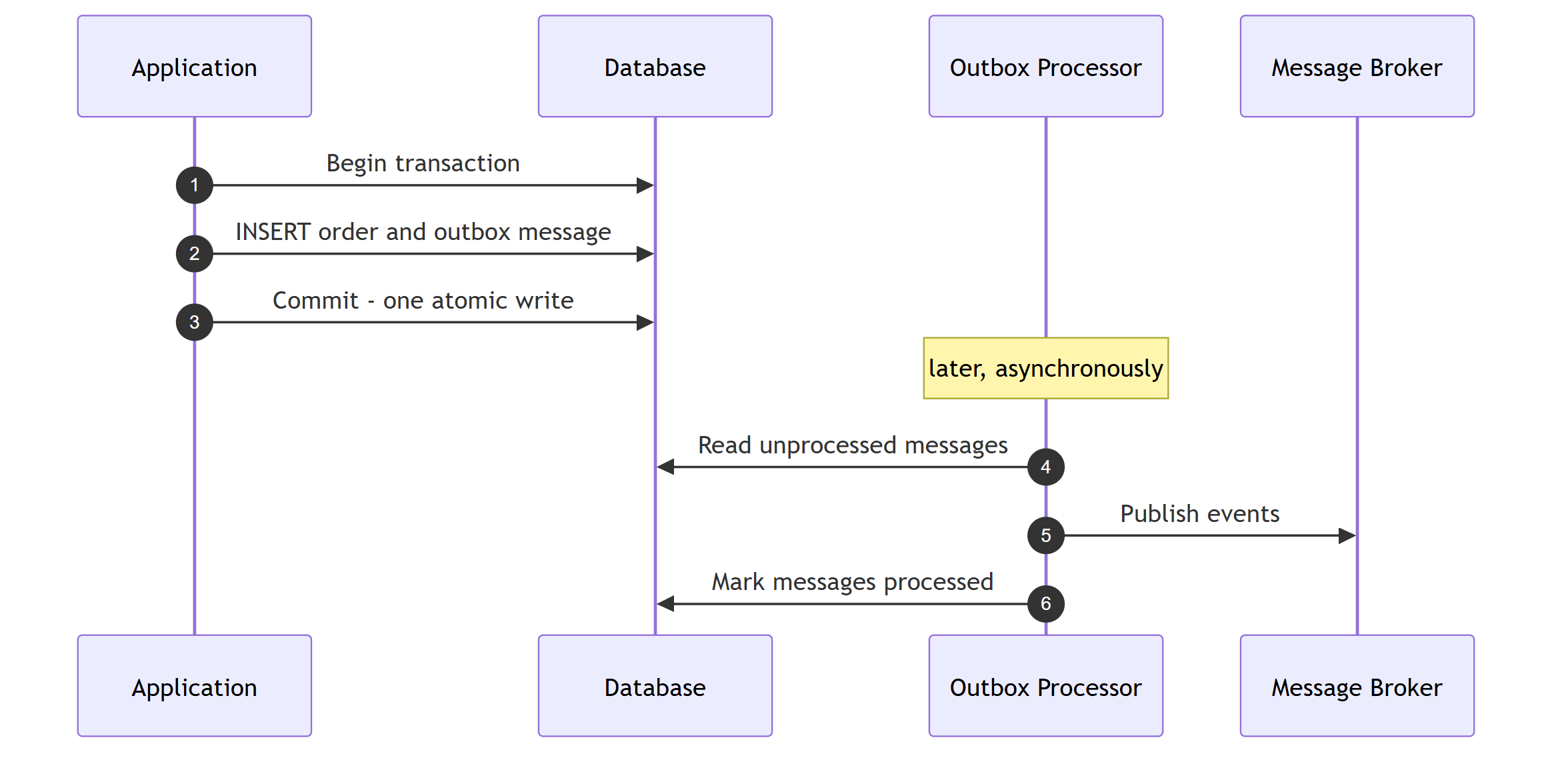
The order insert and the outbox insert commit together. The database guarantees that. Either both rows are committed or neither is. The dual-write problem goes away because there is only one write target.
The publishing step is decoupled and asynchronous. It introduces a small delay, and in exchange no committed event is lost.
The Guarantee
This works because a single database transaction is atomic by definition. By placing the outbox message inside the same transaction as the business data, you use the ACID guarantees your relational database already has instead of trying to invent new ones across system boundaries.
If the transaction commits, both the order and the outbox message are persisted. The processor will eventually pick it up and publish. If the transaction rolls back, neither exists.
There is a trade-off, though.
The outbox processor might publish a message and then crash before marking it as processed. On the next run, it publishes the same message again. This means the Outbox pattern provides at-least-once delivery, not exactly-once. Your consumers must be idempotent: they need to handle receiving the same event twice without producing duplicate side effects.
This is a well-understood trade-off, and idempotency is far easier to implement than distributed transaction coordination. The idempotent consumer pattern shows how to handle duplicate messages cleanly.
A Minimal Example
In .NET with EF Core, the Outbox pattern requires two things: a place to store outbox messages and a mechanism to capture domain events before they leave the transaction.
The outbox entity is straightforward:
public sealed class OutboxMessage
{
    public Guid Id { get; set; }
    public string Type { get; set; } = string.Empty;
    public string Content { get; set; } = string.Empty;
    public DateTime OccurredOnUtc { get; set; }
    public DateTime? ProcessedOnUtc { get; set; }
}
An EF Core interceptor captures domain events and converts them into outbox rows before the transaction commits.
AggregateRoot here is the base class whose DomainEvents collection entities raise events into; the shared kernel article shows the full base type.
public sealed class InsertOutboxMessagesInterceptor : SaveChangesInterceptor
{
    public override ValueTask<InterceptionResult<int>> SavingChangesAsync(
        DbContextEventData eventData,
        InterceptionResult<int> result,
        CancellationToken cancellationToken = default)
    {
        if (eventData.Context is not null)
        {
            InsertOutboxMessages(eventData.Context);
        }

        return base.SavingChangesAsync(eventData, result, cancellationToken);
    }

    private static void InsertOutboxMessages(DbContext context)
    {
        var outboxMessages = context.ChangeTracker
            .Entries<AggregateRoot>()
            .SelectMany(entry =>
            {
                var events = entry.Entity.DomainEvents.ToList();
                entry.Entity.ClearDomainEvents();
                return events;
            })
            .Select(domainEvent => new OutboxMessage
            {
                Id = Guid.NewGuid(),
                Type = domainEvent.GetType().FullName!,
                Content = JsonSerializer.Serialize(domainEvent, domainEvent.GetType()),
                OccurredOnUtc = DateTime.UtcNow
            })
            .ToList();

        context.Set<OutboxMessage>().AddRange(outboxMessages);
    }
}
When SaveChangesAsync is called, this interceptor collects every domain event from modified aggregates, serializes them into JSON, and adds them to the same DbContext. They all commit together. No second system involved.
The Type column stores the full type name (namespace included, assembly not).
The processor has to resolve the CLR type to deserialize the JSON later, and Type.GetType only finds a full name in the calling assembly or the core library.
Resolve it with Assembly.GetType on the assembly that defines your events, or store AssemblyQualifiedName instead.
Wire the interceptor into the module's DbContext registration:
services.AddSingleton<InsertOutboxMessagesInterceptor>();

services.AddDbContext<OrderingDbContext>((sp, options) =>
    options
        .UseNpgsql(config.GetConnectionString("Database"))
        .AddInterceptors(
            sp.GetRequiredService<InsertOutboxMessagesInterceptor>()));
The background processor that publishes these messages is a separate concern. Everything that solves the dual-write problem is in the code above.
For the full end-to-end implementation, including the background worker, see implementing the Outbox pattern. And if you ever need serious throughput, I've written about scaling the Outbox to 2 billion messages per day.
When You Need It (and When You Don't)
The Outbox pattern is the right choice when losing an event has business consequences.
Reach for it when:
- You need reliable event publishing after database writes
- Modules in a modular monolith need to communicate through events
- You're publishing events to external brokers in a microservices architecture
- Consistency between your data and your events is non-negotiable
Skip it when:
- The events are purely informational: analytics pings, debug logs, metrics. If losing a few is acceptable, the added complexity isn't worth it.
- Fire-and-forget notifications where the occasional miss is tolerable.
- Your database supports Change Data Capture (CDC) and you'd rather capture changes at the log level. CDC solves a similar problem from a different angle and avoids the outbox table entirely.
The pattern adds a table, a background processor, and the idempotency requirement on consumers. For any system where "the event must go out if the data was saved," there's no simpler reliable solution.
Summary
The dual-write problem is easy to overlook and painful to debug after the fact. It leaves data inconsistencies that you usually notice long after the write that caused them.
The Outbox pattern solves it by reducing two writes to one. Your database transaction becomes the single source of truth for both business data and events, and the outbox processor publishes the events after that commit.
Thanks for reading, and stay awesome!
Frequently Asked Questions
What is the dual-write problem?
The dual-write problem happens when an application writes to two independent systems, typically a database and a message broker, without a shared transaction. If one write succeeds and the other fails, the systems end up inconsistent.
How does the outbox pattern solve the dual-write problem?
Instead of writing to two systems, you save the business data and the event in the same database transaction, using an outbox table. A background processor then reads the outbox and publishes the events. The database transaction makes both writes atomic.
Does the outbox pattern guarantee exactly-once delivery?
No. It guarantees at-least-once delivery. The processor can crash after publishing but before marking a message processed, so the same event may be published twice. Consumers must be idempotent to handle duplicates.
When should you not use the outbox pattern?
Skip it when losing an occasional event is acceptable, such as analytics pings or debug telemetry. It adds a table, a background processor, and an idempotency requirement, which is not worth it for fire-and-forget notifications.
Is the outbox pattern an alternative to distributed transactions?
Yes. Two-phase commit is slow, poorly supported by modern brokers like Kafka and RabbitMQ, and couples your infrastructure. The outbox pattern achieves reliable event publishing using only local database transactions.


