
Learning roadmap
How to Learn Modular Monolith Architecture
The fastest way to learn modular monolith architecture is a five-step path: understand the tradeoff you are making, define module boundaries with DDD, pick your communication patterns, make messaging reliable, then enforce the architecture and practice extraction. Here is exactly how to do it, with free resources along the way.
Step 1: Understand the monolith vs microservices tradeoff
Before you write any code, understand why this architecture exists. Microservices buy you independent deployments, but they charge for it with network failures, distributed transactions, and heavy operational overhead. Traditional monoliths are simple to run but tend to decay into a big ball of mud. A modular monolith sits deliberately between the two: strict internal boundaries inside a single deployable. If you cannot explain what you are trading away in each direction, you are not ready to pick one.
Free resource: Modular monolith vs. microservices
Step 2: Define module boundaries with DDD and bounded contexts
This is the hardest and most valuable step. A modular monolith with wrong boundaries is just a monolith with extra folders. Use Domain-Driven Design to find bounded contexts in your domain, and let those become your modules. Event Storming is the fastest technique I know for this: get the domain events on a wall, look for the natural seams, and draw module boundaries there. Each module owns its data and exposes a narrow public contract.
Free resource: Bounded contexts in Domain-Driven Design
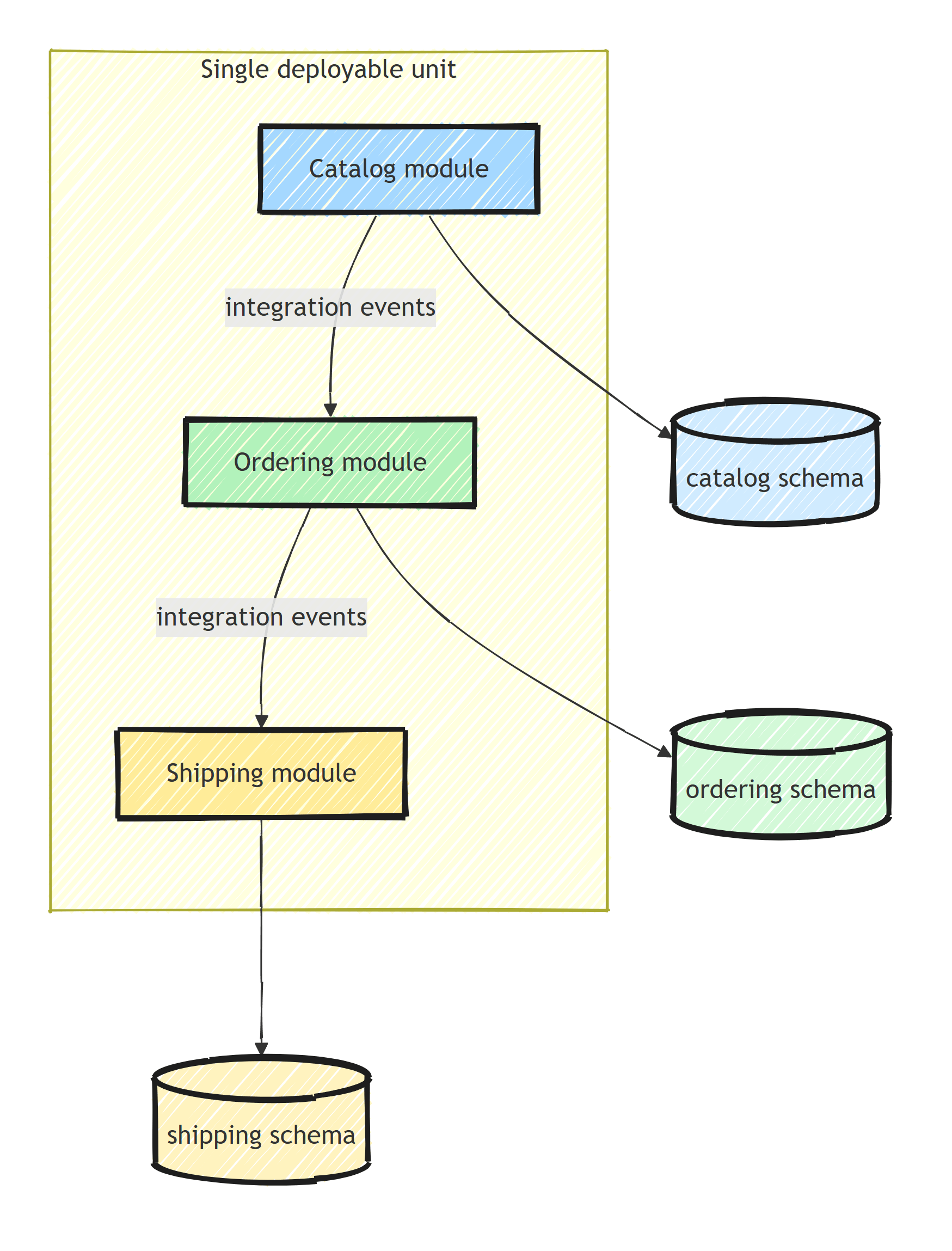
Step 3: Pick your module communication patterns
Modules have to talk to each other, and how they do it determines how decoupled your system really is. You have two options: synchronous calls through a public API (simple, but couples the caller to the callee being available and correct) and asynchronous messaging through events (loosely coupled, but introduces eventual consistency). Learn when each one is appropriate. A good default: synchronous for queries that need an immediate answer, asynchronous for everything that can tolerate a delay.
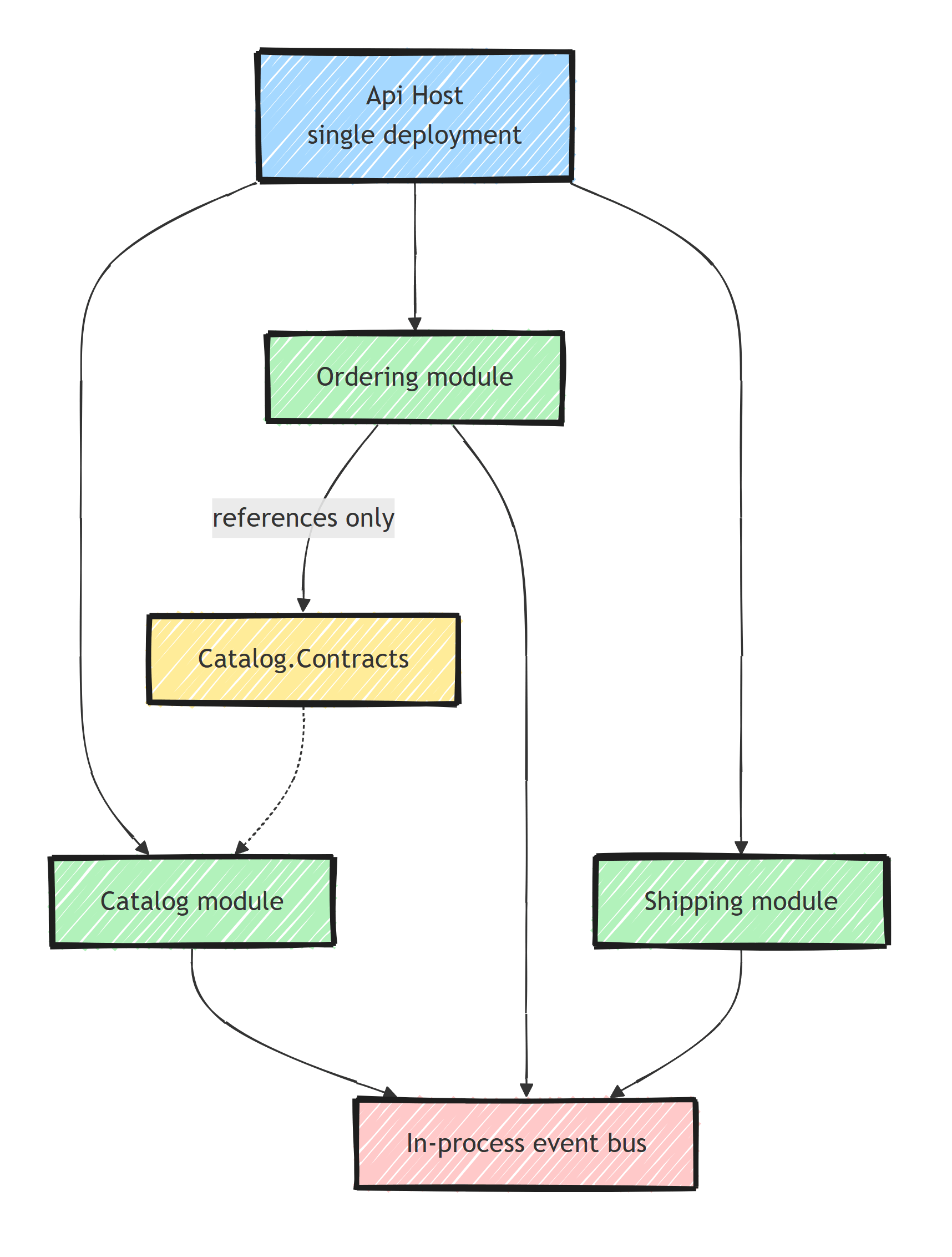
Step 4: Make messaging reliable with Outbox, Inbox, and idempotency
The moment you communicate through events, you inherit a new failure mode: the database transaction commits but the message never gets published, or the message is delivered twice. The Outbox pattern makes publishing atomic with your business transaction. The Inbox pattern plus idempotent consumers make processing safe to retry. Most teams skip this step and discover it in production. Learn it before you need it.
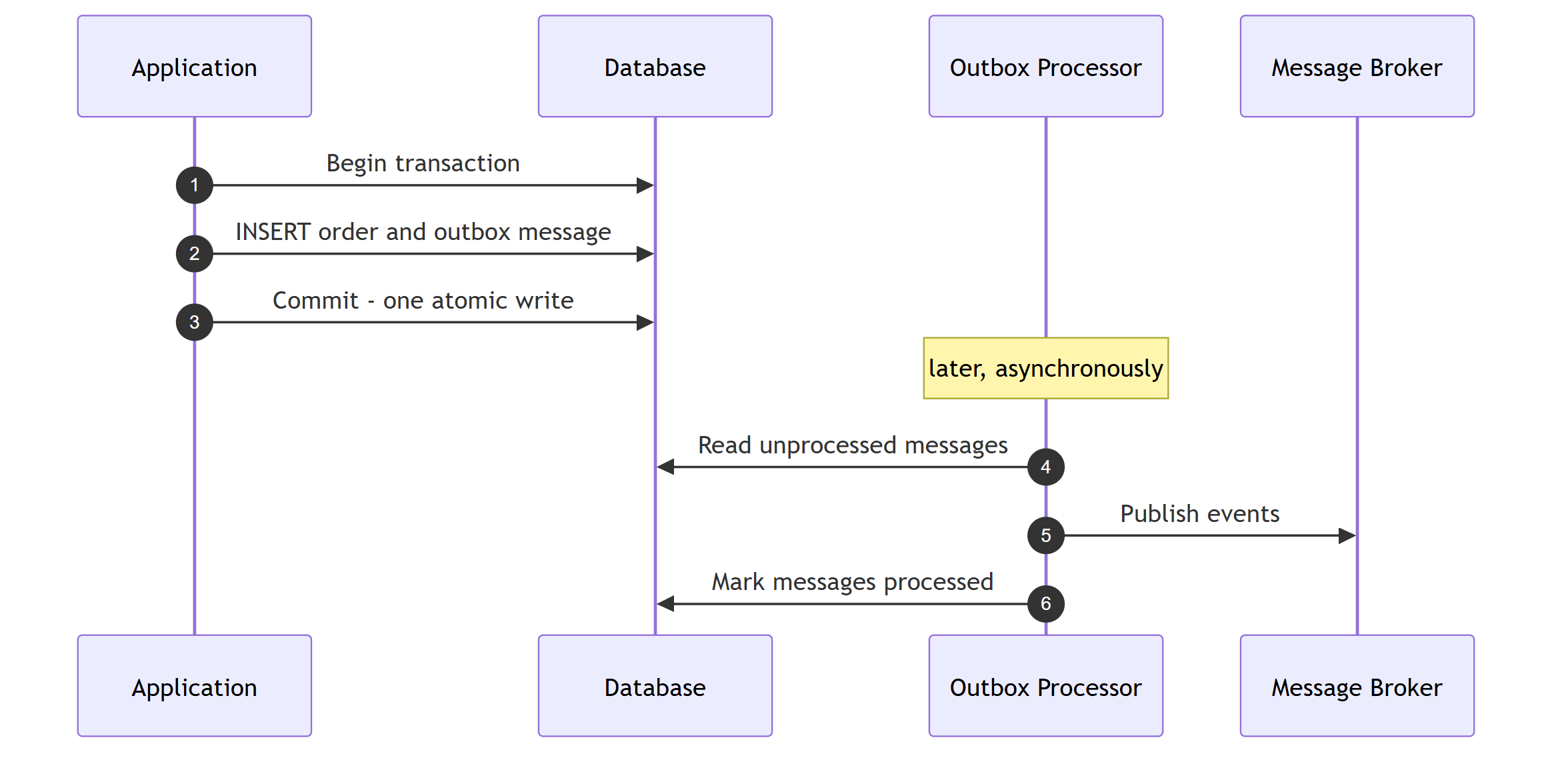
Step 5: Enforce the architecture and practice extraction
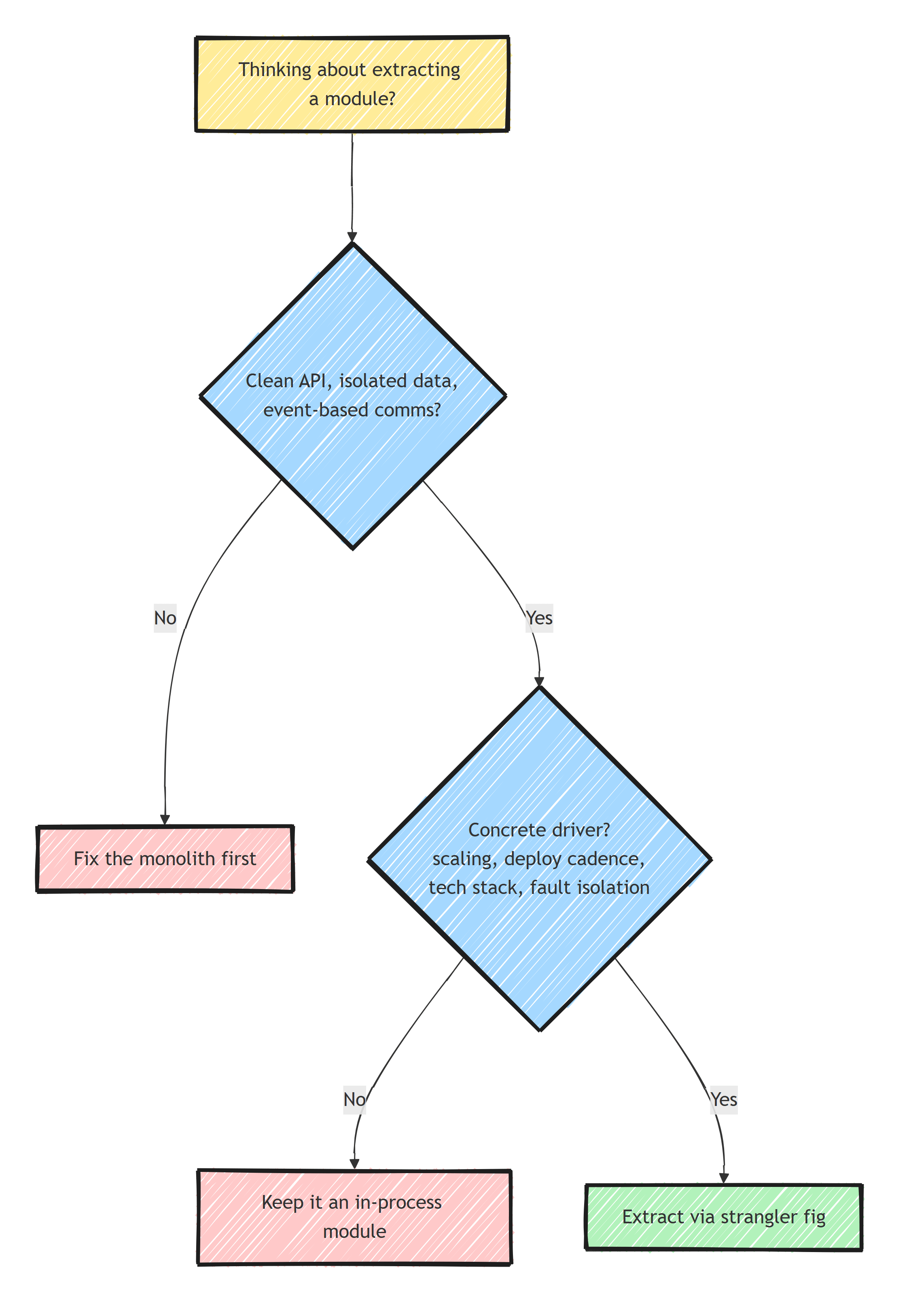
Boundaries only survive if something enforces them. Architecture tests fail the build when someone references another module's internals, which turns your architecture from a convention into a guarantee. Then practice the payoff move: extract one module into a separate service, put an API gateway in front, and swap in-process events for a message broker. Even if you never do it for real, knowing the exit path exists changes how you design.
Free resource: Getting started with microservices in .NET
Want the structured version of this path?
You can learn all of this from free articles, and I have written plenty of them. The tradeoff is time. Boundaries, communication, reliable messaging, and extraction are all decisions that interact with each other, and piecing them together from posts built on different codebases is slow.
Modular Monolith Architecture is this roadmap as one coherent course. We build Evently, an event ticketing platform, from scratch: boundaries with DDD and Event Storming, module communication, Keycloak authentication, Outbox and Inbox messaging, event-driven architecture, architecture testing, and finally extracting a module into a microservice with RabbitMQ and a YARP gateway. 10 chapters, 12+ hours of video, full source code, lifetime access. 2,800+ engineers have taken it.
Frequently asked questions
How long does it take to learn modular monolith architecture?
The concepts take a weekend. Applying them well takes one real project, because the hard part is judgment: where the boundaries go, when modules communicate synchronously, and how to keep them decoupled over time. A structured course compresses this because you watch every one of those decisions get made on a real system.
Do I need to know Domain-Driven Design first?
No, but you will learn it along the way. Module boundaries come from bounded contexts, which is a DDD concept, so the two are best learned together. You need strategic DDD (bounded contexts, event storming) more than the tactical patterns.
What is the difference between a modular monolith and a regular monolith?
Enforced boundaries. A regular monolith lets any class call any other class, which is how it decays into a big ball of mud. A modular monolith splits the system into modules with independent domain models and narrow public contracts, and each module owns its own data. It still deploys as a single application.
What should I know before starting this path?
Comfort building APIs with ASP.NET Core, ideally with Entity Framework Core. About 1 year of hands-on experience is a good baseline. Docker familiarity helps because external services like PostgreSQL and RabbitMQ typically run in containers.
Is there a course that teaches this whole path?
Yes. Modular Monolith Architecture walks through these exact steps on a production-ready system: boundaries with DDD and Event Storming, module communication, Outbox and Inbox messaging, event-driven architecture, architecture testing, and extracting a module to a microservice. 10 chapters, 12+ hours of video, full source code, lifetime access.