
Postgres ignores your index when the predicate is not sargable: when the column side of the comparison is wrapped in a function, a cast, or arithmetic.
The index stores raw column values, so a wrapped column can never seek into it, and the only option left is scanning every row.
The fix is to transform the parameter, not the column, and the only tool that verifies it is EXPLAIN.
Your query returns the right rows and every test is green, but the index you created is never touched.
You won't notice, because nothing fails: the query is correct at 6 rows and a disaster at 60 million, and the difference never shows up in a unit test. It is also, in my experience, the single most common database performance bug in application code, and it usually comes from one innocent-looking habit.
What Makes a Query Non-Sargable?
Say a CI server stores one row per build in a builds table, with an index on result.
You want every build with a given result, case-insensitively, so you write the defensive classic:
SELECT id FROM builds
WHERE lower(result) = lower(@value)
ORDER BY id;
Correct. And the index on result is now useless.
A B-tree index stores the raw column values in sorted order.
Postgres can seek into it for result = 'CANCELLED', but lower(result) is a different value that exists nowhere in the index, so the only option is to compute lower() for every row in the table.
That is a sequential scan, by construction.
This property is called sargability (from "Search ARGument-able"). A predicate is sargable when the column stands alone on its side of the comparison, and any function you wrap around the column prevents an index seek. The same trap shows up in other forms:
lower(email) = lower(@email)and friendsEXTRACT(YEAR FROM placed_at) = 2026, or in EF Core LINQ,o.PlacedAt.Year == year, which translates to exactly thatCAST(id AS text) LIKE @pattern- Arithmetic on the column:
price * 1.2 > @limit
The fix is always the same move: transform the parameter, not the column.
A year filter becomes a range over the raw column (placed_at >= '2026-01-01' AND placed_at < '2027-01-01').
For the case-insensitive comparison, if the data is stored in one consistent case, compare the raw column and let the index seek.
If you need case-insensitivity, put an expression index on lower(result) or use citext, and the wrapped form becomes sargable.
Seeing It: EXPLAIN Is the Only Truth
You cannot confirm this by reading the query, timing it, or counting green tests. You have to read the query plan:
EXPLAIN (FORMAT JSON)
SELECT id FROM builds
WHERE lower(result) = lower(@value)
ORDER BY id;
EXPLAIN without ANALYZE only plans, never executes, so it is safe anywhere.
If the plan tree contains a Seq Scan on your table where you expected an index node, you have your answer.
This mattered enough to me that I built it into a product. Katabench, my coding platform, has a database track where every kata runs your C# (raw SQL via Dapper, or EF Core) against a real, throwaway PostgreSQL instance created for your submission and destroyed afterwards. There are no in-memory fakes (the same approach as Testcontainers), because the planner is the thing being learned.
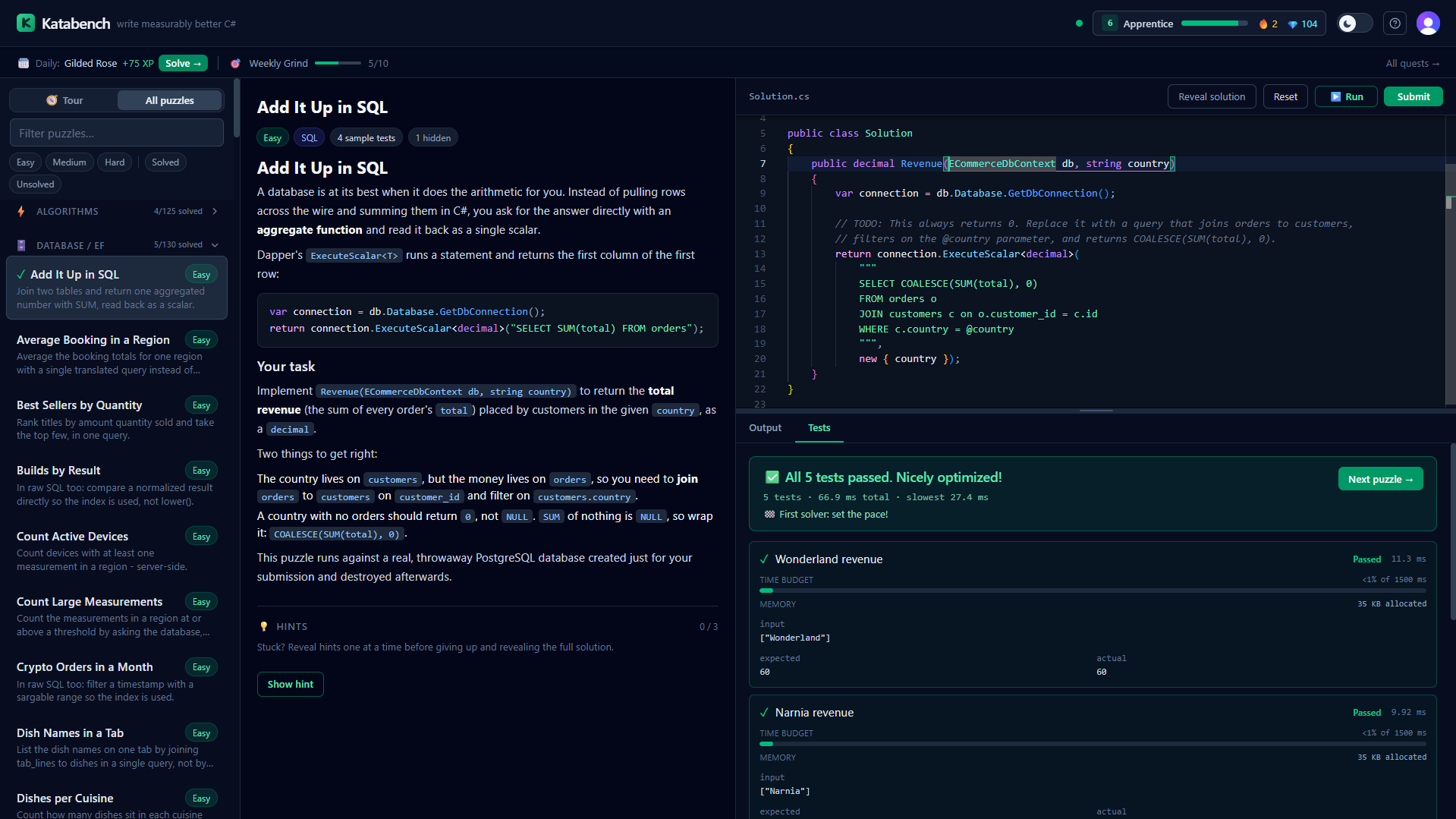
Here is the kata built on exactly the lower() trap ("Builds by Result").
The starter code ships the defensive query, and the interactive Run shows you the SQL your code produced and the plan it got, right under the test:
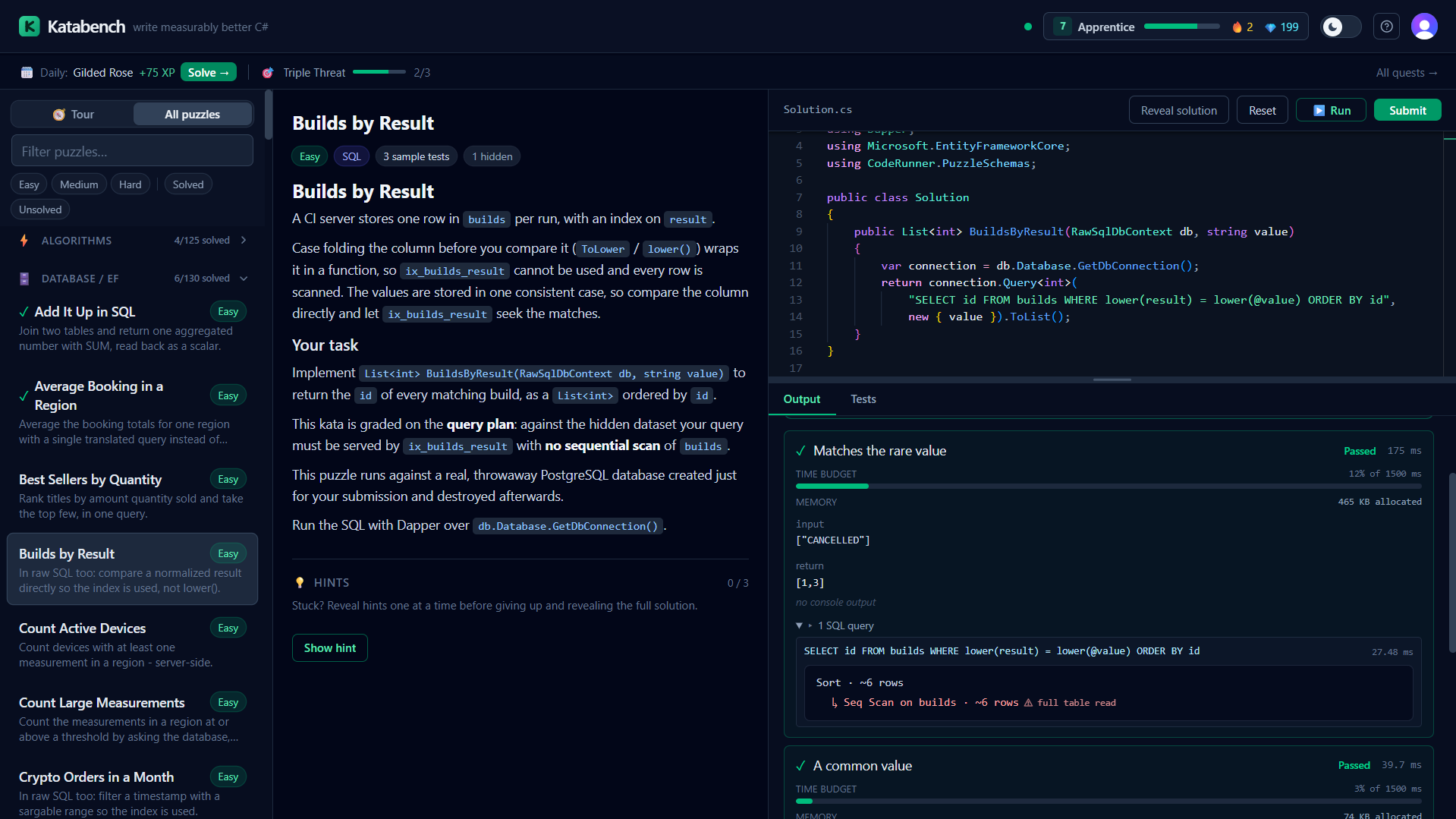
Look at the bottom-right: the test passes (175 ms, well inside budget), and the plan underneath says Seq Scan on builds, full table read.
Grading the Plan, Not the Stopwatch
The design problem in building this kata was that you cannot teach this with a timing gate.
On a small visible fixture, the sequential scan is the fastest plan (reading six rows beats bouncing through an index), so the naive query would pass any latency threshold you set. Worse, on a tiny table Postgres will seq-scan even a perfectly sargable query, because the planner is right to. A timing gate on small data passes the naive query, and a timing gate on huge data is flaky.
So the kata grades the plan itself, against a large hidden dataset (sixty thousand rows, seeded and then ANALYZEd so the planner has accurate statistics).
After the timed runs, the harness re-issues your captured statements as EXPLAIN (FORMAT JSON) with the same bound parameters, and asserts rules over the plan tree: no Seq Scan on builds, the plan must use ix_builds_result, and the answer must be a single statement, one round-trip.
Rewrite the query to compare the raw column, and the verdict flips:
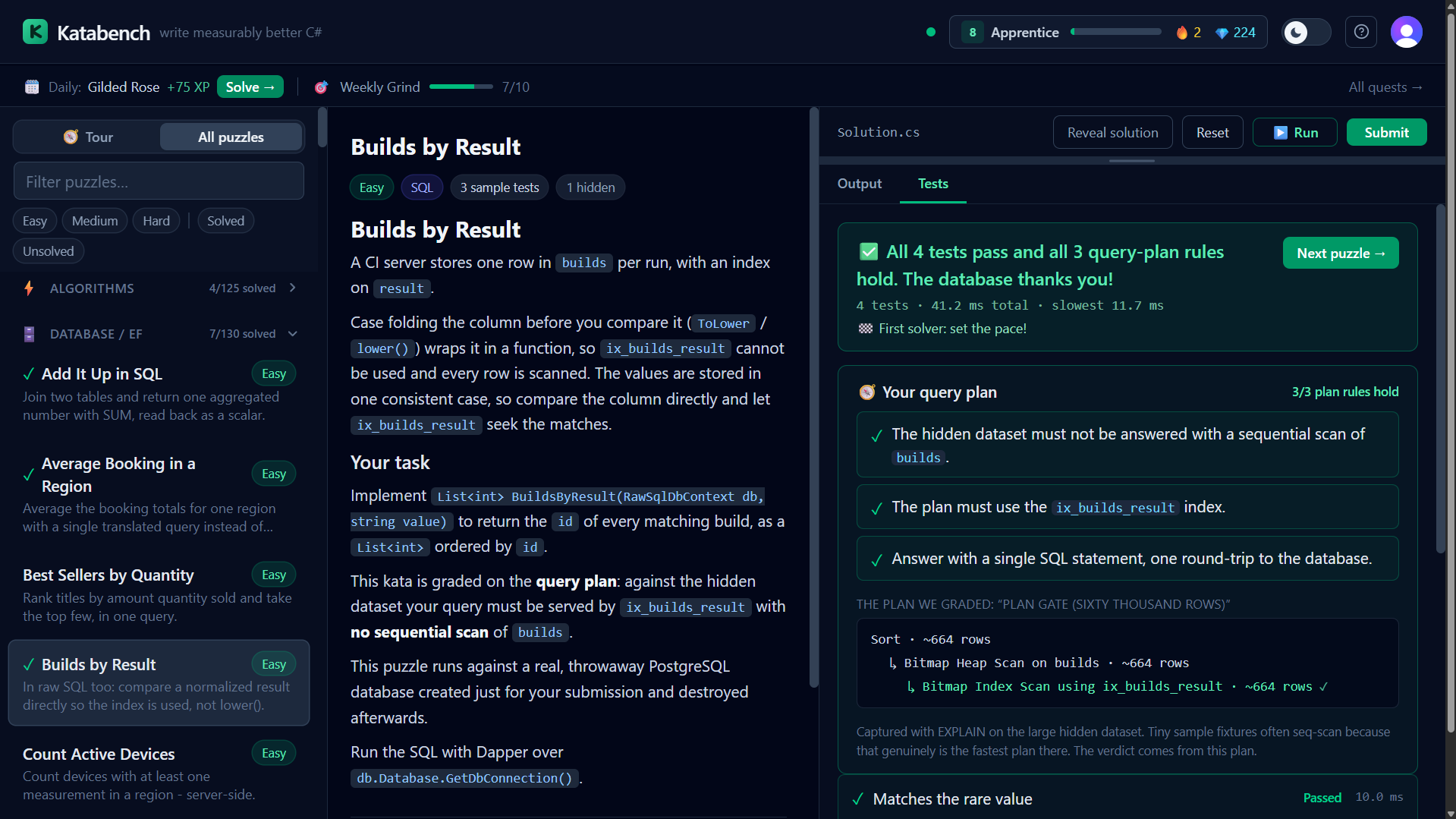
Same green tests, but now the graded plan shows Bitmap Index Scan using ix_builds_result, and all three plan rules hold.
The difference between the two screenshots is one lower() call.
Summary
You can build the reflex without a kata platform.
When you write a WHERE clause, look at which side of the operator the column is on.
If the column is wrapped in anything (a function, a cast, arithmetic, a property extraction that your ORM turns into a function), the index on that column can't be used, and only EXPLAIN on realistic data will tell you.
If you want to practice it, the database track on Katabench fails your query plan until you fix it.
Frequently Asked Questions
What makes a SQL query non-sargable?
Applying a function or expression to the column side of a predicate, for example lower(result) = lower(@value) or extracting the year from a timestamp column. The index stores raw column values, so once the column is wrapped in a function the database cannot seek into the index and falls back to scanning every row.
Why does Postgres use a sequential scan instead of my index?
Either the predicate is non-sargable, so the index is unusable, or the planner correctly estimates that a sequential scan is cheaper, which is common on small tables where reading everything beats index round-trips. Check with EXPLAIN on a realistically sized dataset with fresh statistics (run ANALYZE) before concluding the index is broken.
How do I check whether a query actually uses an index?
Prefix the query with EXPLAIN and read the plan tree: an Index Scan, Index Only Scan, or Bitmap Index Scan node naming your index means it is used; a Seq Scan on the table means it is not. EXPLAIN without ANALYZE only plans the query and never executes it, so it is safe to run against production.
How do I make a case-insensitive comparison use an index?
Three options: store the data in one consistent case and compare the raw column, create an expression index on lower(column) so the wrapped form becomes indexable, or use the citext type which makes comparisons case-insensitive at the type level. Wrapping both sides in lower() at query time without an expression index scans the whole table.


