
My job queue on NATS JetStream is two file-backed streams: a work-queue stream where a pool of workers competes on one durable pull consumer, and a short-retention results stream that the API awaits for the outcome. Jobs survive worker crashes and broker restarts, and one ordering rule keeps results safe: publish the result before you ack the job.
Katabench grades code submissions in a worker pool: the API accepts a submission, a worker compiles and executes it in a sandbox, and the user waits for the verdict. Between the API and the workers sits a queue, and my hard constraint for it was that a user always gets their result or a retriable error, never a silent loss.
My first transport failed that constraint twice, and the fix shows what a real job queue gives you.
Where Does the Redis List Design Lose Jobs?
Version one was the classic minimal queue: a Redis list.
The API does RPUSH, workers poll with LPOP, results go into a per-job key with a TTL.
It can lose a job in two ways, and both are structural:
LPOPremoves the job with no acknowledgment. A worker that crashes mid-job (and mine run untrusted code, so crashing is normal operation) takes the job with it. Nothing redelivers it.- No persistence. An in-memory Redis restart or redeploy wipes the queue and every in-flight result.
You can patch around both (use LMOVE to a processing list, add AOF persistence, build a sweeper for stuck jobs), but at that point you are hand-building acknowledgments and durability.
That is exactly the feature set of a real message broker.
I picked NATS JetStream over RabbitMQ for one operational reason: it is a single lightweight binary that is trivial to run on a VPS, and it plugs straight into the Prometheus and Grafana stack I already had. I covered the fundamentals in getting started with NATS JetStream in .NET; this is what the production shape looks like.
The Shape: Two Streams
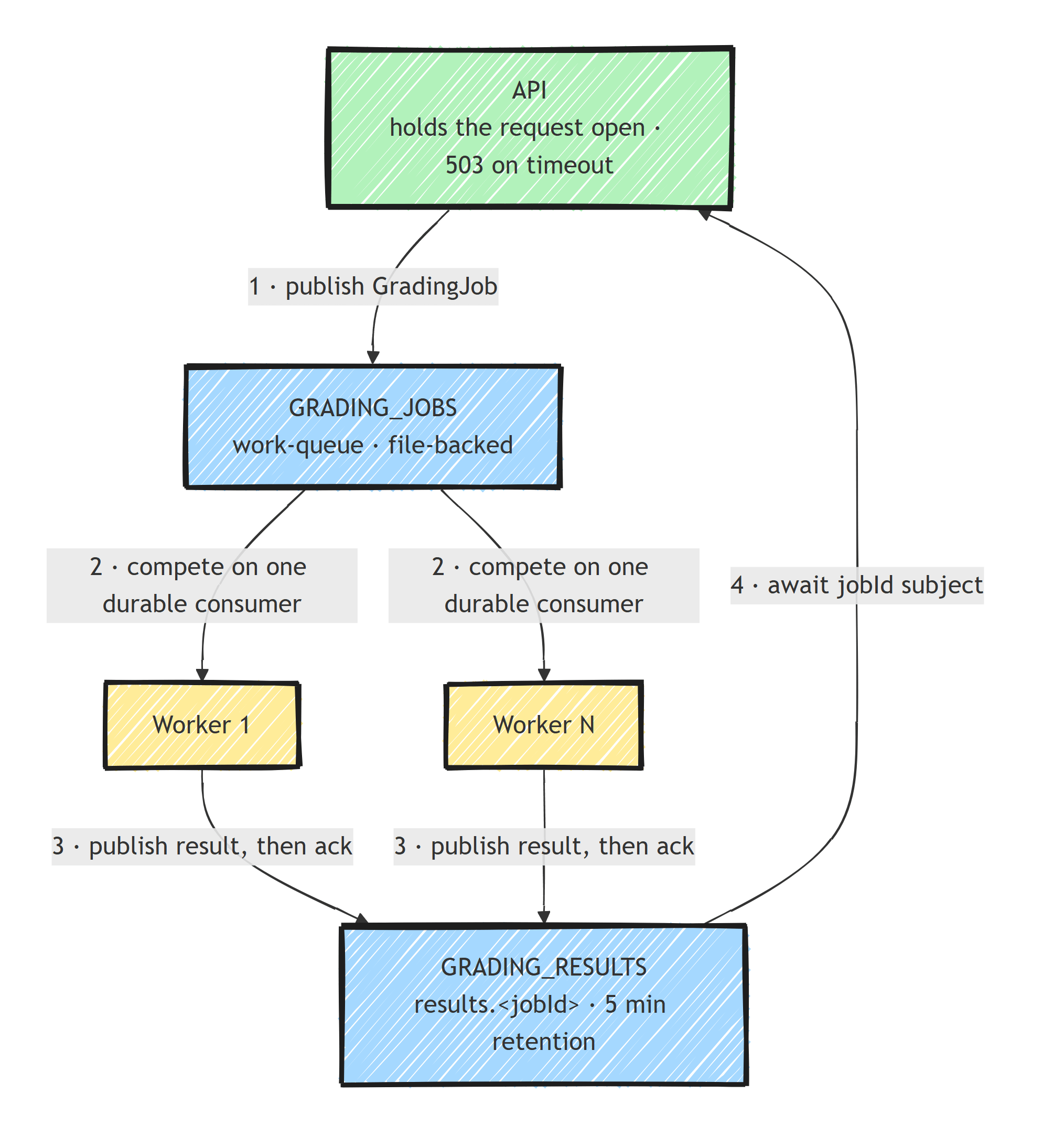
Everything is built on two file-backed streams:
var js = new NatsJSContext(connection);

// The job queue: a message is removed once a worker acks it.
await js.CreateStreamAsync(new StreamConfig("GRADING_JOBS", ["grading.jobs"])
{
    Retention = StreamConfigRetention.Workqueue,
    Storage = StreamConfigStorage.File
});

// Results: short retention, one subject per job id.
await js.CreateStreamAsync(new StreamConfig("GRADING_RESULTS", ["grading.results.>"])
{
    Retention = StreamConfigRetention.Limits,
    MaxAge = TimeSpan.FromMinutes(5),
    Storage = StreamConfigStorage.File
});
The jobs stream uses work-queue retention: JetStream deletes a message once a consumer acks it, so the stream behaves like a queue instead of a log. All workers compete on one shared durable pull consumer, which is how you get the competing-consumers pattern; adding a worker is just starting another process, with zero configuration.
The worker publishes each outcome to the results stream on grading.results.<jobId>, and the API awaits it with an ephemeral ordered consumer filtered to that one subject.
Because the stream retains messages for a few minutes, a result that was published before the API started waiting is still delivered.
That closes an entire class of races that a fire-and-forget reply channel has.
The One Ordering Rule That Matters
The worker loop looks like this, and the order of the last two lines is what makes it reliable:
var consumer = await js.CreateOrUpdateConsumerAsync("GRADING_JOBS",
    new ConsumerConfig("workers")
    {
        AckWait = TimeSpan.FromSeconds(60), // redeliver if no ack in time
        MaxDeliver = 4                      // bounded poison retry
    });

await foreach (var msg in consumer.ConsumeAsync<GradingJob>(cancellationToken: ct))
{
    GradingJobOutcome outcome = await grader.GradeAsync(msg.Data, ct);

    // Publish the result FIRST, then ack the job.
    await js.PublishAsync($"grading.results.{msg.Data.JobId}", outcome, cancellationToken: ct);
    await msg.AckAsync(cancellationToken: ct);
}
Publish the result before you ack the job. Walk the failure windows and you'll see why:
- Crash before the publish: the job is un-acked, so JetStream redelivers it after
AckWaitand another worker grades it. Nothing is lost. - Crash between publish and ack: the job is redelivered and graded again, and a second identical result is published. Grading is idempotent and keyed by job id, so the duplicate is harmless.
Ack first and you reopen the Redis hole: a crash after the ack but before the publish loses the result with no way to recover it.
MaxDeliver handles the adversarial case.
A submission that reproducibly crashes its worker (I run untrusted code, so this will happen) is redelivered a bounded number of times and then dropped, and JetStream emits a MAX_DELIVERIES advisory that monitoring alerts on.
Without it, one poison job crash-loops your whole worker pool forever.
Masking It All Behind a Synchronous API
From the user's perspective nothing here is asynchronous: the API holds the HTTP request open, awaits the result subject up to a dispatch budget, and returns a retriable 503 on timeout. Every failure mode above degrades to "try again", never to a missing result.
Two limitations to know before you copy this design:
- A single NATS node is a single point of failure. Jobs survive a restart (file-backed streams), but not a dead disk. Clustered JetStream with RAFT replicas is the fix when you outgrow one box; at my volume, one box is fine.
- The results stream is retention-bounded. If a client should be able to fetch a result hours later, the queue is the wrong home for it; persist results to Postgres and treat the stream purely as transport.
And if you want to see the queue from the user's side, every submission on Katabench rides through it, a few hundred milliseconds at a time.
Summary
- Work-queue retention makes the jobs stream behave like a queue: acking a job deletes it, and each delivery goes to exactly one worker (a job that isn't acked in time is delivered again).
- One shared durable pull consumer gives you competing consumers; adding a worker is just starting another process.
- Publish the result before you ack the job. Every crash window then degrades to a redelivery, and idempotent grading keyed by job id makes duplicates harmless.
AckWaitbounds a crashed worker (the job is redelivered to another worker) andMaxDeliverbounds a poison job (dropped after a bounded number of attempts, with aMAX_DELIVERIESadvisory to alert on).- The API stays synchronous: it awaits the results stream and returns a retriable 503 on timeout, never a silent loss.
Frequently Asked Questions
Why use NATS JetStream instead of Redis for a job queue?
A Redis list gives you LPUSH and LPOP but no acknowledgment: once a worker pops a job, a crash loses it, and without persistence a Redis restart wipes the whole queue. JetStream gives you file-backed streams and consumer acknowledgments, so an unacked job is redelivered after a visibility window and jobs survive broker restarts. As a single lightweight binary, NATS is also much easier to operate on a VPS than a full RabbitMQ deployment.
What happens if a worker crashes in the middle of a job?
The job stays unacknowledged, so JetStream redelivers it to another worker after the AckWait window expires. As long as job processing is idempotent, keyed by a job id, the redelivered job is processed again and the client never notices.
How do you handle poison messages in NATS JetStream?
Set MaxDeliver on the consumer. A job that reproducibly crashes its worker is redelivered a bounded number of times and then dropped, and JetStream emits a MAX_DELIVERIES advisory event you can alert on. The waiting client gets a timeout instead of an infinite crash loop.
What is work-queue retention in JetStream?
A retention policy where a message is removed from the stream once a consumer acknowledges it. That makes the stream behave like a classic job queue: each delivery goes to one member of the worker pool, and acknowledged jobs do not accumulate. Delivery is still at-least-once, so a job that is not acked in time is redelivered and can be processed again.


