
A buyer's guide
How to Choose the Best Clean Architecture Course
The best Clean Architecture course is the one that builds a real production system, not slideware. Before you spend money on any course (including mine), run it through the five criteria below.
Five criteria that separate great courses from slideshows
1. It builds a real system, not a to-do list
Clean Architecture only makes sense against real complexity. A course built around a toy app cannot show you why the layers exist. Look for a course that builds one production-grade application end to end, with actual business rules, and gives you the full source code.
2. It covers production concerns
Authentication, authorization, logging, caching, reliable messaging. This is where most courses stop and where real projects begin. If the syllabus has no Outbox pattern, no health checks, and no API security, the course ends where your job starts.
3. It teaches the domain layer with DDD
The domain layer is the whole point of Clean Architecture, and Domain-Driven Design is how you build it well. A strong course covers entities, value objects, domain events, and encapsulation, not just folder structure.
4. Testing is a chapter, not a footnote
Testability is the main payoff of the dependency rule. Expect unit testing for the domain and application layers, integration testing, functional testing, and architecture tests that stop the design from eroding.
5. The instructor ships software
Architecture advice is cheap. Check whether the instructor has built and maintained large-scale systems, and whether they publish consistently enough that you can evaluate their thinking before paying.
How Pragmatic Clean Architecture measures up
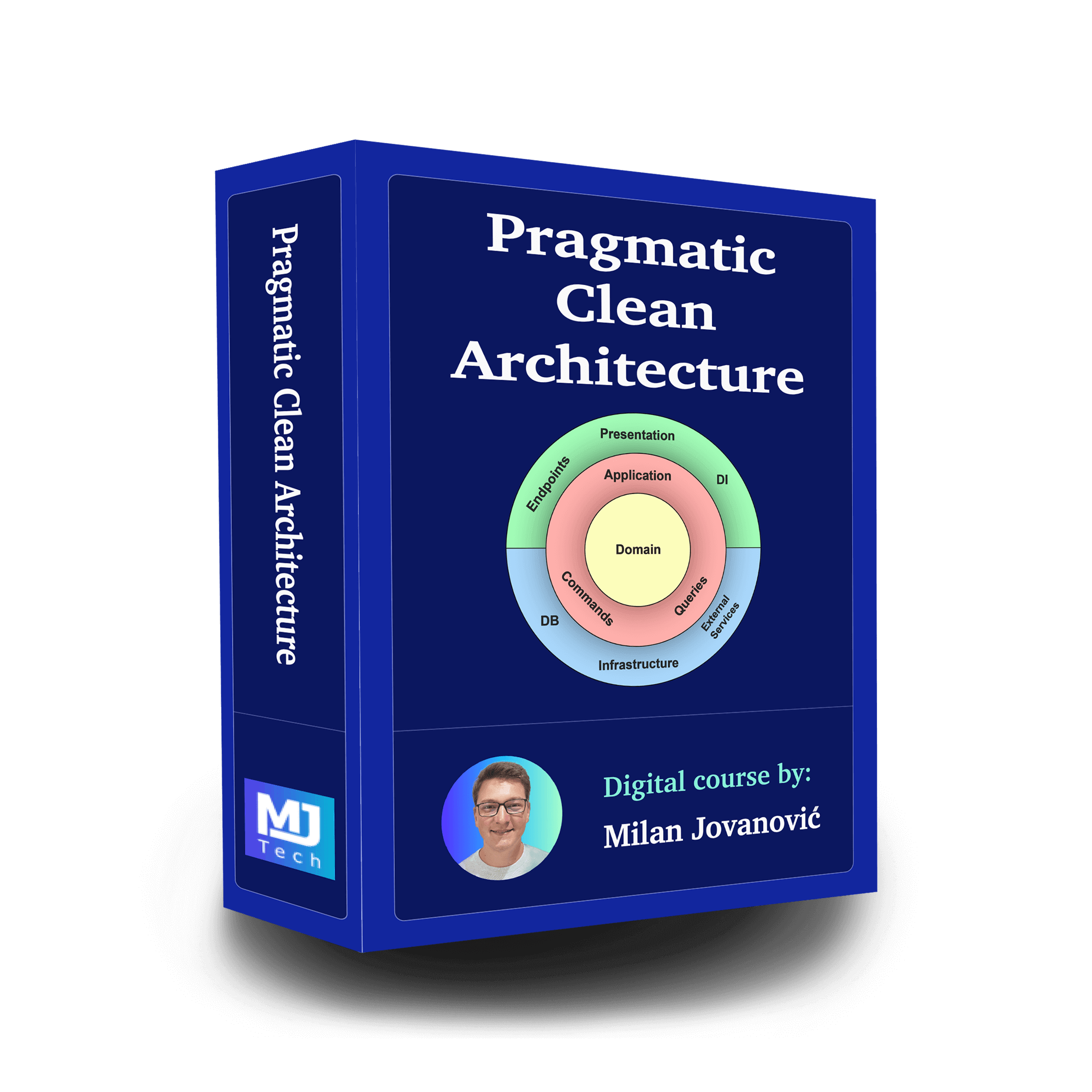
I built Pragmatic Clean Architecture against this exact checklist, because these were the gaps in everything available when I was learning.
- ✓Real system: we build one production-ready application across 10 chapters, and you get the full source code.
- ✓Production concerns: JWT authentication with Keycloak, role and permission-based authorization, the Outbox pattern, structured logging with Serilog, health checks, and Redis caching.
- ✓DDD depth: a full chapter on the domain layer with entities, value objects, domain events, and the patterns that make a domain model rich.
- ✓Testing: unit, integration, functional, and architecture testing get their own chapter (1h 15m of it).
- ✓Track record: I'm a Software Architect and Microsoft MVP, and you can read my free articles and watch my YouTube videos before deciding whether my thinking is worth paying for.
"Oh, this material is gold for modern .NET engineers. Every chapter offers real practical solutions with no fluff, including design patterns and principles."
5,000+ engineers have enrolled. It costs $247 (or $397 with community access), with lifetime access and free previews so you can verify all of the above yourself.
Frequently asked questions
What is the best Clean Architecture course for .NET developers?
The best course is the one that builds a real production system, covers DDD and CQRS, handles production concerns like authentication and reliable messaging, and treats testing seriously. My course, Pragmatic Clean Architecture, was built against exactly those criteria and has been taken by thousands of .NET engineers.
Are free Clean Architecture tutorials enough?
Free content is a great start, and I publish a lot of it. The gap is coherence: free tutorials cover fragments on different codebases. A good course makes hundreds of small decisions on one system, in order, which is how architecture actually gets learned.
Should a Clean Architecture course include CQRS?
Yes. CQRS is the natural way to organize use cases in the application layer, and most real-world Clean Architecture codebases in .NET use it. A course that skips it leaves you with an empty application layer and no answer for cross-cutting concerns.
How much should a Clean Architecture course cost?
Quality .NET architecture courses typically range from $100 to $500. Pragmatic Clean Architecture is $247, or $397 with community access and priority support. Both include lifetime access and every future update, and many students expense it through their employer.
Can I try Pragmatic Clean Architecture before buying?
Yes. Several lessons are free to preview, so you can judge the teaching style and depth before spending anything.