
Ubiquitous language is the shared vocabulary that developers and domain experts use in conversations, documentation, and code within one bounded context. Use business terms for types, operations, and tests, then refine them as the team learns. The same word can have a different meaning in another context.
The Translation Problem
A business person says: "The customer submits an order."
A developer writes:
public void InsertRecord(DataTransferObject dto)
{
    var entity = _mapper.Map<OrderEntity>(dto);
    _dbContext.OrderEntities.Add(entity);
    _dbContext.SaveChanges();
}
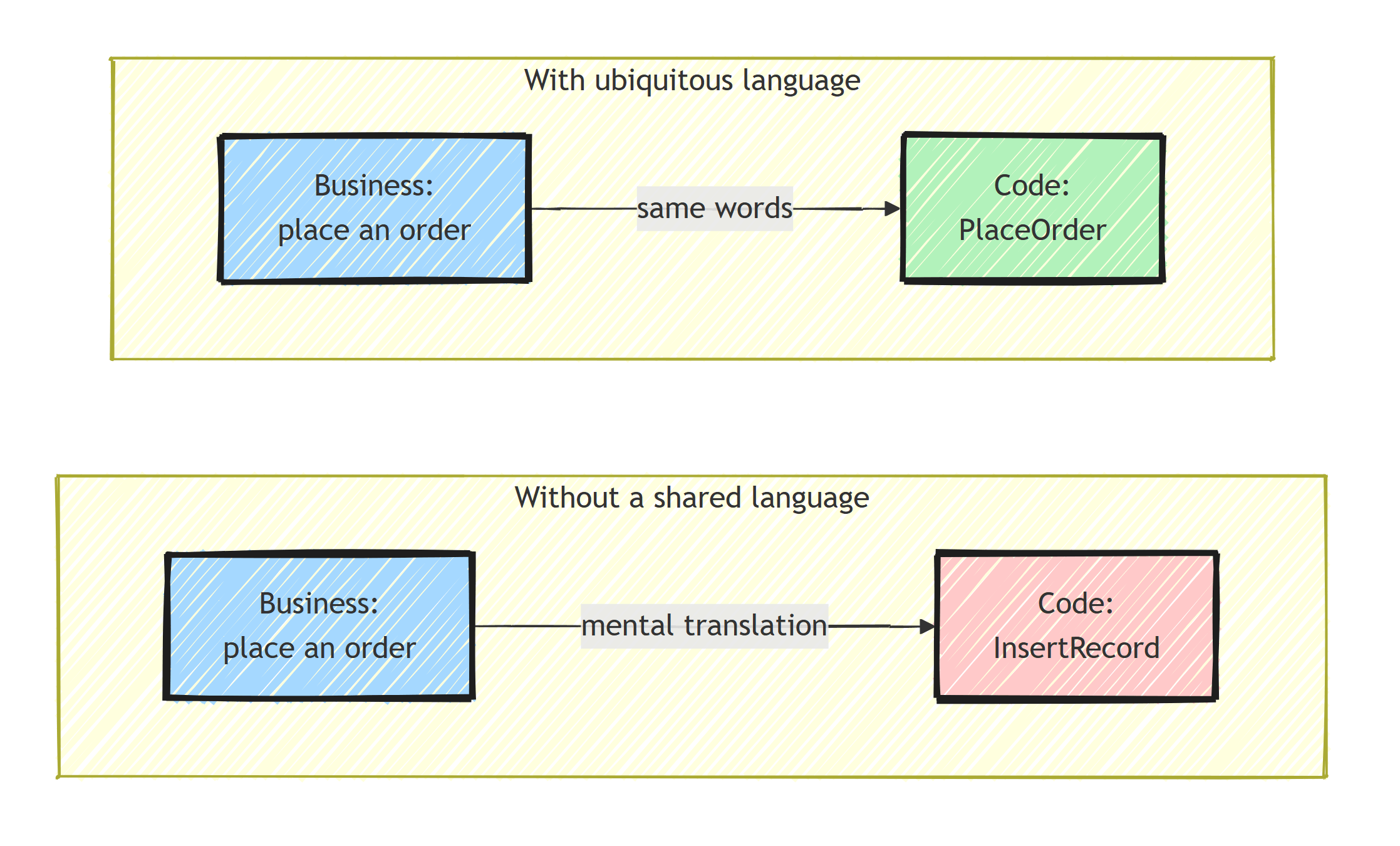
The business says "submit." The code says "insert." The business says "customer." The code says "DTO." The business says "order." The code says "entity."
Every conversation requires mental translation. This is where bugs and misunderstandings live.
What Is Ubiquitous Language?
Ubiquitous Language is the practice of using the same words in conversations, documentation, and code. When a domain expert says "order is placed," your code should read:
public sealed class PlaceOrderHandler(IOrderRepository orders)
{
    public async Task Handle(Guid customerId, CancellationToken ct)
    {
        var order = Order.Create(customerId);
        order.Place();
        await orders.SaveAsync(order, ct);
    }
}

public interface IOrderRepository
{
    Task SaveAsync(Order order, CancellationToken ct);
}
The handler uses the Order type defined below.
Its repository implementation owns the database save; the handler names the business operation.
Eric Evans introduced this concept in his book Domain-Driven Design. Martin Fowler describes how the language and model evolve together. The key insight: ambiguity in language causes ambiguity in software.
It's the foundation everything else in Domain-Driven Design builds on. You can skip aggregates and value objects and still get value from DDD. You can't skip the language.
Building the Ubiquitous Language
1. Listen to Domain Experts
When talking to business stakeholders, write down the words they use:
- "The customer places an order"
- "We ship the order from the warehouse"
- "If the payment is declined, the order is cancelled"
- "A VIP customer gets free express shipping"
These words - customer, order, ship, warehouse, payment, declined, cancelled, VIP customer, express shipping - are your Ubiquitous Language.
2. Use Those Words In Code
Map domain terms directly to classes, methods, and properties. This small in-memory example focuses on the order lifecycle; a real ordering model also enforces its line-item and pricing rules:
public enum OrderStatus { Draft, Placed, Cancelled, Shipped }
public abstract record OrderEvent(Guid OrderId);
public sealed record OrderPlaced(Guid OrderId) : OrderEvent(OrderId);
public sealed record OrderCancelled(Guid OrderId, string Reason) : OrderEvent(OrderId);
public sealed record OrderShipped(Guid OrderId, Guid WarehouseId) : OrderEvent(OrderId);

public sealed class Order
{
    private readonly List<OrderEvent> _events = [];
    private Order(Guid customerId) => CustomerId = customerId;

    public Guid Id { get; } = Guid.NewGuid();
    public Guid CustomerId { get; }
    public OrderStatus Status { get; private set; } = OrderStatus.Draft;
    public string? CancellationReason { get; private set; }
    public Guid? ShippedFromWarehouseId { get; private set; }
    public IReadOnlyList<OrderEvent> Events => _events.AsReadOnly();

    public static Order Create(Guid customerId)
    {
        if (customerId == Guid.Empty)
            throw new ArgumentException("Customer ID is required.");
        return new Order(customerId);
    }

    public void Place()
    {
        if (Status != OrderStatus.Draft)
            throw new InvalidOperationException("Only draft orders can be placed.");

        Status = OrderStatus.Placed;
        _events.Add(new OrderPlaced(Id));
    }

    public void Cancel(string reason)
    {
        if (Status == OrderStatus.Shipped)
            throw new InvalidOperationException("Cannot cancel a shipped order.");
        if (Status == OrderStatus.Cancelled)
            throw new InvalidOperationException("Order is already cancelled.");
        ArgumentException.ThrowIfNullOrWhiteSpace(reason);

        Status = OrderStatus.Cancelled;
        CancellationReason = reason;
        _events.Add(new OrderCancelled(Id, reason));
    }

    public void Ship(Guid warehouseId)
    {
        if (Status != OrderStatus.Placed)
            throw new InvalidOperationException("Only placed orders can be shipped.");
        if (warehouseId == Guid.Empty)
            throw new ArgumentException("Warehouse ID is required.");

        Status = OrderStatus.Shipped;
        ShippedFromWarehouseId = warehouseId;
        _events.Add(new OrderShipped(Id, warehouseId));
    }

    public void ClearEvents() => _events.Clear();
}
Notice the method names: Place(), Cancel(), Ship(). Not UpdateStatus(), SetInactive(), Process(). The code matches how the business talks about orders.
The domain events follow the same rule: OrderPlaced, OrderShipped. Past-tense facts, named the way the business would describe them.
The application must capture these events for dispatch before clearing them; an in-memory list alone does not provide reliable delivery.
3. Don't Invent Technical Names
Replace developer-invented terms with the words the business actually uses:
Order, notOrderEntityPlaceOrder(), notInsertOrder()CancelOrder()andShipOrder(), notUpdateOrderStatus()OrderSummary, notOrderDTOChargePayment(), notProcessPayment()Customer, notUserRecordDeactivateAccount(), notFlagAsInactive()
If a business person wouldn't say it, don't put it in your domain model.
Where the Language Lives in a .NET Codebase
Ubiquitous Language isn't just entity names. It should show up at every level:
- Commands and queries:
PlaceOrderCommand,UpgradeToVipCommand- one per business operation, named as the business names them - Domain events:
OrderPlaced,PaymentDeclined- past-tense business facts - Enums and statuses:
OrderStatus.Placed, notOrderStatus.State2 - Error codes:
Order.CannotCancelShippedreads like the rule it enforces - Project and namespace names:
Sales.Domain,Shipping.Application- the bounded contexts themselves
When the language is consistent across all of these, a new developer can learn the business by reading the solution explorer.
Force Precision When the Business Is Vague
Domain experts sometimes use words loosely. "The order is done."
Done as in paid? Shipped? Delivered? Closed after the return window?
This is where Ubiquitous Language earns its keep: the modeling conversation forces the business to pick precise terms. You'll often discover that "done" is actually three different states, each with different rules. That discovery is a requirements bug caught before a line of code was written. A facilitated EventStorming workshop is one practical way to surface those terms and disagreements with the whole domain team.
Keep the agreed terms in a glossary next to the code (a markdown file in the repository works fine). When a term changes or a new one appears, update the glossary in the same pull request that renames the code.
Ubiquitous Language and Bounded Contexts
The same word can mean different things in different contexts. A "Customer" in the Sales context is someone who places orders. A "Customer" in the Support context is someone who files tickets.
Each Bounded Context has its own Ubiquitous Language. These read-model records illustrate the different information each context needs:
namespace Sales.Domain
{
    public sealed record Customer(Guid Id, string Name, decimal CreditLimit, bool IsVip);
}

namespace Support.Domain
{
    public enum SupportTier { Standard, Priority }
    public sealed record Customer(
        Guid Id, string Name, SupportTier Tier, string PreferredContactMethod);
}
Two Customer classes with different properties because they represent different concepts. This is expected and correct. Don't force a single Customer class to serve both contexts - that creates a Big Ball of Mud.
Testing With Ubiquitous Language
In an xUnit test project, the same Order type supports tests written in the business language:
using Xunit;

public sealed class OrderTests
{
    [Fact]
    public void Placed_order_can_be_cancelled()
    {
        var order = Order.Create(Guid.NewGuid());
        order.Place();

        order.Cancel("Customer changed their mind");

        Assert.Equal(OrderStatus.Cancelled, order.Status);
        Assert.Equal("Customer changed their mind", order.CancellationReason);
    }

    [Fact]
    public void Shipped_order_cannot_be_cancelled()
    {
        var order = Order.Create(Guid.NewGuid());
        order.Place();
        order.Ship(Guid.NewGuid());

        var error = Assert.Throws<InvalidOperationException>(
            () => order.Cancel("Too late"));

        Assert.Equal("Cannot cancel a shipped order.", error.Message);
        Assert.Equal(OrderStatus.Shipped, order.Status);
    }
}
A domain expert can read these tests and confirm: "Yes, that's how the business works."
Common Mistakes
Using CRUD language for domain operations. "Create order" is CRUD. "Place order" is domain language. "Update customer" is CRUD. "Upgrade customer to VIP" is domain language.
Mixing contexts. Using Sales terminology in the Support context creates confusion. Each context owns its own language.
Not evolving the language. The business changes. "Priority shipping" becomes "express shipping." Update the code to match. Refactor the names when the language evolves.
Letting the language drift inside a growing context. When one bounded context accumulates multiple vocabularies (the same module talks about "clients", "customers", and "accounts"), that's often a sign the context should be split. I wrote about this in refactoring overgrown bounded contexts.
Summary
Ubiquitous Language eliminates the translation layer between business and code:
- Listen to how domain experts talk about the business
- Use their exact words in your code
- Respect context boundaries - same word, different meaning
- Write tests in the domain language
- Evolve the language as the business evolves
When a domain expert can read your code and understand it, you've successfully applied Ubiquitous Language.
Thanks for reading.
And stay awesome!
Frequently Asked Questions
What is ubiquitous language in DDD?
Ubiquitous language is the practice of using the same vocabulary in conversations, documentation, and code. If the business says "place an order", the code has a PlaceOrder method, not InsertRecord or UpdateStatus.
Why is ubiquitous language important?
Every translation between business terms and technical terms is a place where misunderstandings and bugs hide. A shared language removes the translation layer, so domain experts can validate the model and even read the tests.
Can the same term mean different things in different bounded contexts?
Yes, and it should. A Customer in Sales and a Customer in Support are different models with different properties. Each bounded context owns its own ubiquitous language.
How do you capture ubiquitous language in practice?
Write down the exact words domain experts use in requirements sessions or event storming workshops, keep a glossary in the repository, and refactor code names whenever the business language evolves.
Is CRUD language part of ubiquitous language?
Usually not. Create, update, and delete describe database operations, not business behavior. The business says place, cancel, ship, or upgrade, and those verbs belong in the domain model.


