

Choose the status code class from the outcome: 2xx means success, 4xx means the caller must change something, 5xx means the server must fix something. The ambiguous cases each resolve with one question: 400 vs 422 is "schema or rules?", 401 vs 403 is "who are you vs you may not", 404 vs 410 is "unknown vs deliberately gone". And never return 200 with an error in the body.
Nobody has ever argued about 200 OK or 500 Internal Server Error.
The design review fights are about the ambiguous middle: is invalid input 400 or 422?
Is a missing permission 401 or 403?
And someone always suggests returning 200 with "success": false, which hides every failure from monitoring.
Caches, retry policies, and alerting all make decisions based on the status code. Here is the decision tree for every ambiguous case I keep re-litigating, with the ASP.NET Core mappings.
If you have a specific API outcome in front of you, use the interactive HTTP Status Code Wizard to get a recommendation, Problem Details response, and ASP.NET Core examples.
Why Do Status Codes Matter?
A status code is a machine-readable statement of a request's outcome, and three audiences consume it without reading your docs:
- Infrastructure: CDNs cache 200s and 404s, never 500s. Proxies and gateways count 5xx for health. Get the class wrong and caching or failover misbehaves.
- Client retry logic: 429 and 503 are retryable, 400 and 422 are not. A client that cannot tell them apart either retries forever or gives up on transient failures.
- Your own observability: alerts fire on 5xx rates. Errors hidden inside 200s never page anyone.
The class is the contract: 2xx success, 4xx the caller must change something, 5xx we must fix something. The decisions below pick a specific code within a class.
400 vs 422: Could Not Read It vs Could Not Accept It
The most common fight, and the line is clean:
- 400 Bad Request: the request is malformed. Broken JSON, a string where a number belongs, missing structural pieces. The message never made it to your domain logic.
- 422 Unprocessable Entity: the request parsed perfectly, and your rules rejected the content. End date before start date. Quantity of -5. A taken username looks similar but is a 409 (next section).
If a schema validator could have caught it, return 400. If it needed your business rules, return 422.
ASP.NET Core nudges you here already: model binding and JSON deserialization failures produce 400 automatically, and validation frameworks report rule violations, which you map to 422:
app.MapPost("/api/bookings", async (
    CreateBookingRequest request,
    IValidator<CreateBookingRequest> validator) =>
{
    // Malformed JSON never reaches this line - the framework already sent 400

    var validation = await validator.ValidateAsync(request);

    if (!validation.IsValid)
    {
        return Results.ValidationProblem(
            validation.ToDictionary(),
            statusCode: StatusCodes.Status422UnprocessableEntity);
    }

    // ...
});
Both should carry a Problem Details body naming the offending fields. The status tells clients whether to fix the request; the body tells them what to fix. Wire that up once with FluentValidation and an exception handler, and the decision is made in one place.
401 vs 403: Who Are You vs You Specifically, No
Misnamed by history (401 Unauthorized is actually about authentication), so ignore the names and use the semantics:
- 401: I do not know who you are. Token missing, expired, or invalid. 401 asks the client to authenticate and try again (the
WWW-Authenticateheader is part of the contract). - 403: I know exactly who you are, and you may not do this. Valid token, insufficient permissions. Retrying with the same identity will never help.
403 also confirms that the resource exists and that the caller's identity was understood. For resources whose existence is itself sensitive (other tenants' data), many APIs return 404 instead of 403, and that is a legitimate, documented choice. I went deeper on this pair in 401 vs 403 in ASP.NET Core, including how the authentication and authorization middleware pick between them for you.
404 vs 410: Not Here vs Gone Forever
- 404 Not Found: nothing at this address (or nothing I will admit to). Safe default, no promises about the past or future.
- 410 Gone: this existed, it was removed on purpose, and it is not coming back. Deleted user accounts, expired one-time links, sunset API versions.
410 tells consumers to delete their references and stop retrying, and tells search crawlers to de-index now instead of revisiting. Use it when you can verify the past existence (soft-deleted rows make this trivial); use 404 when you cannot or will not.
For sunsetting old API versions, return 410 with a body pointing at the migration guide.
409: The State Says No, For Now
409 Conflict covers requests that are well-formed and pass validation, but collide with current state:
- Creating something that already exists (duplicate username, duplicate SKU).
- Optimistic concurrency failures: the resource changed since you read it (412 if you are using
If-Matchpreconditions, 409 for application-detected conflicts). - State machine violations: cancelling an order that already shipped.
The distinction from 422: a 422 request can never succeed as written; a 409 request might succeed at another time or after a re-read. A client's conflict-resolution logic keys on that difference.
The 2xx Family Beyond 200
Underused, and each one carries real information:
- 201 Created: resource creation succeeded; include a
Locationheader pointing at the new resource.Results.Created()does both. - 202 Accepted: work accepted, not done. Use it for async APIs for long-running requests: return 202 plus a status URL, not a 200 held for 30 seconds.
- 204 No Content: success with nothing to say. The natural response for DELETE and for PUT/PATCH when you do not echo the resource.
The 200-With-Error-Body Lie
Every few months someone proposes the envelope:
HTTP/1.1 200 OK

{ "success": false, "error": "Order not found" }
The arguments for it ("clients only need one parsing path", "some proxies eat 4xx bodies") were weak in 2015 and are dead now. What it actually does:
- Monitoring goes blind. Error rate dashboards read 0% while customers see failures.
- Caches store failures. A CDN caches that 200 "not found" and serves it after the order exists.
- Retry logic breaks. Nothing distinguishes transient from permanent, so clients retry nothing or everything.
- Every client must learn your envelope, re-implementing what HTTP already standardized.
A status code that contradicts the body misleads every intermediary between you and the caller. If the operation failed, the status is 4xx or 5xx, full stop. (GraphQL's 200-always model is the one principled exception, and it ships an entire error specification to compensate.)
The Cheat Sheet
The whole flow, from an incoming request down to a status code, is one walk through a series of questions:
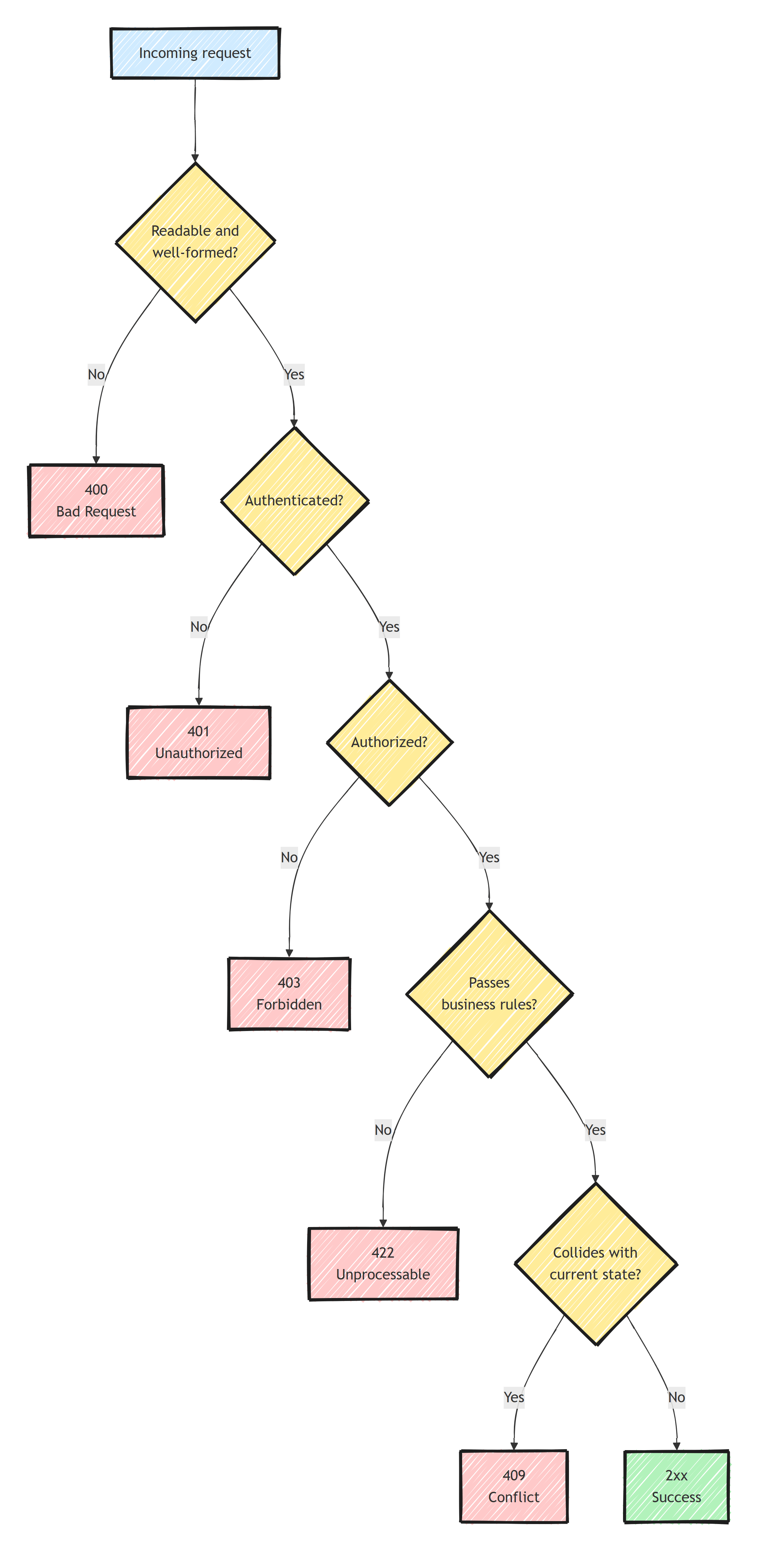
The decision tree, compressed:
- Request unreadable or structurally invalid: 400
- No valid credentials: 401
- Valid credentials, insufficient rights: 403 (or 404 to hide existence)
- No such resource: 404
- Existed and was permanently removed: 410
- Readable but violates business rules as written: 422
- Valid but collides with current state: 409 (412 with preconditions)
- Over the rate limit: 429, with the headers from communicating 429s properly
- Created: 201 + Location. Accepted for later: 202 + status URL. Done, nothing to return: 204
- We broke: 500. Dependency broke: 502. We are overloaded or down on purpose: 503 + Retry-After
Summary
Status codes are the part of your API contract that machines act on without asking. The ambiguous cases stop being ambiguous with the right question: 400 vs 422 is "schema or rules?", 401 vs 403 is "who are you vs you may not", 404 vs 410 is "unknown vs gone on purpose", 422 vs 409 is "never valid vs not valid right now".
Encode the decisions once (validation filter, exception handler, Problem Details everywhere) so individual endpoints cannot pick their own codes. And never return 200 with an error body, or your dashboard will show 0% errors during an outage.
Frequently Asked Questions
What is the difference between 400 and 422?
Use 400 when the request is malformed and could not be understood: broken JSON, wrong types, missing required structure. Use 422 when the request was perfectly readable but fails your business rules: an end date before a start date, an amount over the limit.
When should I use 401 vs 403?
401 means "I do not know who you are": credentials missing, expired, or invalid, and retrying with valid credentials could succeed. 403 means "I know exactly who you are, and the answer is no": authentication succeeded but the caller lacks permission.
Is it OK to return 200 with an error in the body?
No. Status codes are the contract that caches, proxies, monitoring, and client retry logic all key on. A 200 carrying an error body makes failures invisible to every layer of infrastructure and forces every client to parse your custom envelope to learn what HTTP already says.
When should an API return 404 vs 410?
Return 404 when the resource does not exist or you will not confirm it exists. Return 410 Gone when the resource verifiably existed and was permanently removed, which tells clients and crawlers to stop trying and delete their references.


